
Author: Dr. Jen
Read Time: Snuggle up, this could take a bit…
In my practice, one of the first things I want to know about my clients is what their attachment style is. As far as pop-psychology goes, attachment styles have become rather mainstream over the past few years. So much so, that I’m willing to bet that a lot of you reading this right now have heard about attachment styles, might know what yours is, and perhaps even know why knowing your attachment style matters. Good for you! Now, even if you do know something about attachment styles, and what yours is, I think a little refresher course is never a bad idea… And for those who don’t know what attachment styles are, you’ve come to the right place. Here we go!
Back in 1957-ish John Bowlby and Mary Ainsworth created a draft idea they called Attachment Theory. In 1969 this theory was more formally launched in published research articles and books. Over the years there have been some tweaks, but overall, the theory/idea holds true. Essentially, attachment theory helps explain why we interact with people the way that we do, based on understanding how a person perceives themselves and others. Before we dig into each of the four attachment styles and their details, I want to say this loud and clear: Attachment style is simply one piece of the much larger and more complex puzzle that is our whole being. What that means is, your attachment style tells you something, but not everything. And (important!) your attachment style can change over time (intentionally with work, or without your knowing because of experiences). So, although I lean on this set of concepts heavily in my practice, it is neither the only thing that matters, nor always the most prevailing thing that matters when it comes to relationship communication and success.
Attachment Styles 101:
- Your attachment style is formed from experiences in your early life.
- Your attachment style is solidified by the relational experiences you have over your lifetime.
- You can work to “earn” a Secure attachment style; often you will need coaching/therapy/counseling during this journey.
- Your attachment style does impact the way you communicate in all relationships (e.g., with friends, family, romantic partners, even at work!)
- Attachment styles are meant to be thought of as a “spectrum concept” meaning you won’t ever be fully one style 100%, but, rather more likely, you’ll be a blend of a few styles together with one being more dominant. For the sake of simplicity of explanation, I’m going to walk you through each style as if you would land in the middle of each quadrant.
Back when I was teaching college classes, the model I used to explain attachment styles looked like this:
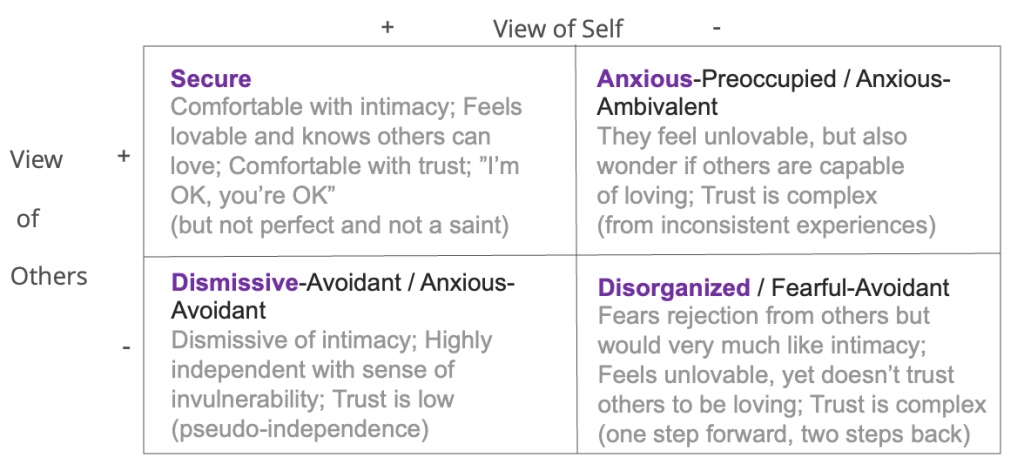
Based on the combination of positive / negative view of self, and positive / negative view of others, you fall into one of the four attachment style quadrants. As you move from quadrant to quadrant, you can begin to see the patterned ways we might interact with people in our life based on if you have a positive/negative view of self and others.
Secure Attachment:
The attachment style practitioners often help clients achieve through coaching/therapy and some focused effort is the secure attachment style. I like to think of securely attached individuals as “universal donors” in social settings… It’s not that securely attached people don’t get nervous, or ever over-think things, or stress about their relationships, but they have an easier time pushing forward, having the tough conversations, and sorting out what they need, and what others might need in any given moment. Securely attached individuals possess a confidence in self and others that enables them to take responsibility when needed, but also understand the other party has some responsibility to take here. Securely attached folks also tend to trust themselves and others in many ways: trust themselves and others to do the “right” thing, or to apologize if the “wrong thing” happened, or to be able to move forward, or to figure out a complicated relationship situation. You might begin to understand why, if you are not securely attached, working towards that attachment style could be a good idea for relational health and success.
Dismissive Attachment:
When you combine a negative view of others with a positive view of self, you get the dismissive attachment style. This style often looks like someone setting their partner up to fail and then leaving when that inevitable failure occurs. Let’s be kind though. This setting up to fail is not done intentionally or maliciously (most of the time); it happens because the person with a dismissive attachment style is programmed to believe that people will. let. you. down. And self-fulfilling prophecies are very much a real thing. So, you might see a dismissively attached person setting impossible standards, or only giving a few chances before quietly (or loudly) exiting the relationship. Because the dismissively attached person has been hurt often by others in the past, they have a coat of armor on to protect from more damage. They might keep people at a distance, be very slow to “warm up” to others, and put people through a lot of secret tests to earn trust. And once trust is broken? It is o.v.e.r. Now, this paints these people as cold and unwilling to bond, but that just isn’t true! Everyone needs connection and those with a dismissive attachment style are of no exception. But this attachment style creates a very complex environment in which to grow close to someone.
Anxious Attachment:
The anxious attachment style often arises because as a young person, caregivers were inconsistently present and absent, helpful and hurtful, open and closed, warm and cold. As a product of those inconsistent, seemingly random and chaotic interactions, anxiety crept into the psyche of that individual. As a result of this anxious attachment style, you will often see people over-think, cling, pepper others with questions and a need for detailed information/explanations, and do their very best to be an award-winning partner (by their standards). Sadly, this behavior often drives away the very person they are trying to get close to, and/or cling to. Thus, another relationship ends and the anxiously attached person gets to think, “well, I still don’t know what went wrong, but I’ll keep trying even harder next time.” The anxious attachment style comes with a negative view of self and positive view of others. This can be on the dangerous side if mixed with a partner who exploits the positive view of others. Put simply, anxiously attached individuals can be compelled to believe that abuse is warranted, acceptable even. Please, do not fall prey to this trap. There is never a case in which abuse (physical or emotional) is ever even remotely ok.
Disorganized Attachment:
When you combine a negative view of self and a negative view of others, you come away with a disorganized attachment style. This style is the most chaotic of all because the individual often wonders, “how can this relationship thing ever work?!” They do not have a lot of confidence they can make a relationship work, but they also don’t have a lot of confidence the other person can either. Thus, a disorganized-ly attached individual takes one step forward in a relationship, only to become a bit unnerved and then take a step or two back. This comes into play because as a young person, caregivers were negative, rejecting, or even abusive toward the child; the child was taught they are the problem, but also that caregivers aren’t that great either. As an adult, a disorganized attachment style will lead you to often encounter a person who struggles to lead, know what they need/want, and also struggles to get what they need/want. They want connection, but getting that might seem like a puzzle too complicated to solve.
Now, that is just each attachment style in isolation…but relationships take (at least) two to tango! What happens when you mix different attachment styles together?
Often, a securely attached individual can help non-securely attached individuals trust, not over-think, be open, and take appropriate accountability/responsibility. But, that can often also be exhausting for the securely attached!
If you combine a dismissively attached with an anxiously attached individual, you get a vicious cycle of clinging and pushing away that makes both individuals rather miserable.
Adding a disorganized-ly attached individual with either anxious or dismissive can also often create a relationship filled with rollercoaster-like feelings and uncertainty because there seems to be no clear path toward trust and stability in anyone’s previous experiences.
What I want to be a key take-away here for you, dear reader, is simply this: you need to know your attachment style and that of your partner. This knowledge will help you understand why you and your partner react to one another in the ways that you do. Be a detective: look for the clues to help you see how your communication patterns are being driven by what lies beneath. Do you react strongly to uncertainty? Do you push waaaaay back when trust begins to waver? Do you try to draw closer at the slightest tremor of distance in the relationship? What might some of these larger, snap reactions, point to when it comes to previous relationship experiences (and those with your caregivers when you were a child?) These are the sorts of things you need to begin to observe, ask yourself, and seek to answer in order to begin to create more effective, positive, and enriching communication in your relationships.
I will end by saying, each non-secure attachment style has it’s own unique strengths, too. Dismissive attachment makes you see very clearly what you need and want. Anxious attachment makes you hyper-vigilant so you can actually sense change more quickly than others. Disorganized attachment keeps you open-minded to change, because you understand anything could happen at any time.
Want to begin to understand your attachment style? I am a big fan of The Attachment Project and their online, self-assessment: Take the quiz here and begin the journey to greater understanding!
And, if coaching is something that appeals to you, in order to learn more and do some work on yourself, hey, you know where to find me! 😉



 Love Wins Relationship & Communication Coaching Blog
Leave a comment